
Cracking the Construction Crisis: Workforce Solutions for Alberta’s Rapidly Growing Trades Corridor

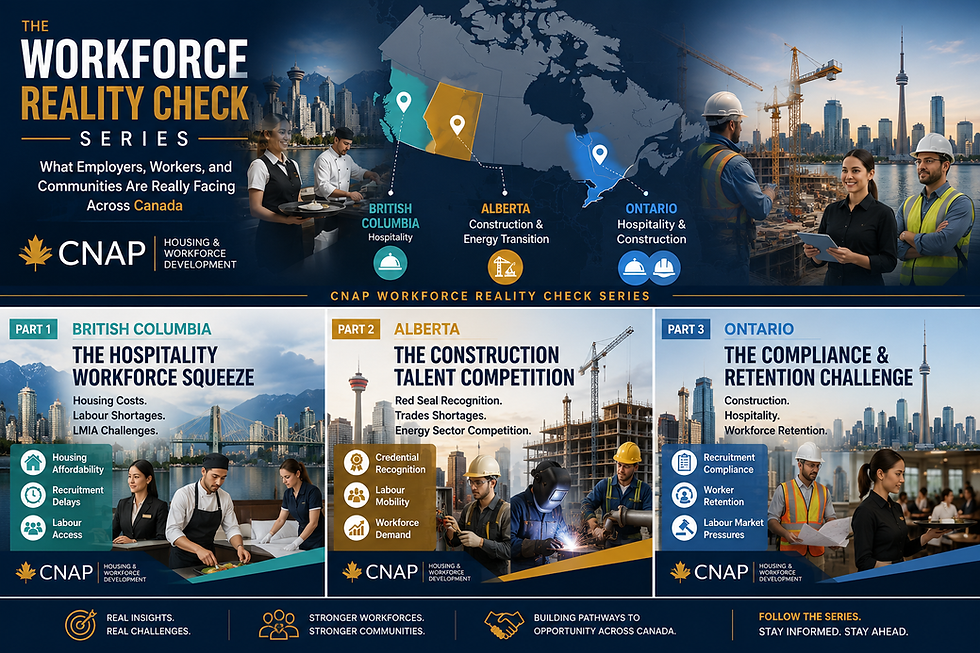
Part 2 of the CNAP Workforce Reality Check Series. Part 1 examined BC's hospitality workforce squeeze.
Alberta is posting record construction numbers — and running out of workers to build them. Calgary and Edmonton are absorbing one of the fastest-growing populations in the country, while the province's energy sector transition is driving simultaneous, competing demand for the same skilled industrial trades.
General contractors and developers are caught between an expanding pipeline and a shrinking, contested labour pool.
At the Canadian Network Advantage Program (CNAP- NGO), we work with builders and employers to move past unpredictable temporary worker pipelines and establish sustainable, permanent, highly skilled workforces.
The Pain Points Paralyzing Alberta's Construction Sector
Pain Point 1: High-Wage Threshold Constraints
Recent federal updates have significantly raised the hourly wage floors required to secure high-wage LMIAs. For major trades — framing, electrical, and plumbing — in Calgary and Edmonton, these mandatory thresholds are driving up overall labour costs across active project budgets.
Contractors are caught between thin project margins and strict federal wage rules. There is limited room to absorb cost increases mid-project, and the LMIA pathway adds months of administrative burden before a single worker is onboarded.
Pain Point 2: The Credential Recognition Bottleneck
Internationally trained tradespeople arrive in Alberta ready to work — and are immediately slowed by provincial credential processes. Navigating Alberta Apprenticeship and Industry Training (AIT) requirements to verify foreign work hours and achieve Red Seal equivalence takes months under standard timelines.
Fully qualified tradespeople spend weeks classified as general labourers while credential assessments proceed. Projects that depend on certified journeypersons cannot absorb that gap.
Pain Point 3: The Energy Sector Poaching Cycle
Residential homebuilders compete for labour against clean energy and oil infrastructure projects that carry fundamentally different budget structures.
Large-scale industrial energy projects routinely outbid municipal contractors for the same pool of skilled welders, heavy equipment operators, and industrial electricians — and the attrition this creates directly slows housing development targets that Alberta communities are counting on.
This is not a temporary disruption. It is a structural feature of Alberta's economy that requires a structural response.
The CNAP Framework: Three Actionable Solutions
Solution 1: Virtual Pre-Arrival Credential Mapping
CNAP eliminates onboarding delays by initiating the trade certification process before workers arrive in Canada. We collect international work histories, verify hours, and map them directly against Alberta AIT trade requirements — before a worker boards a flight.
The result: new arrivals can challenge their qualification exams within 14 days of landing. They reach active work sites faster, with full certification pathways already underway.
Solution 2: Fast-Tracking via Category-Based Selection
Rather than routing employers through the LMIA process, CNAP sources talent directly from the federal Express Entry pool via the Trade Occupations Category-Based Selection stream. Workers arrive in Alberta as full Permanent Residents from day one.
This removes administrative friction entirely. Permanent residents build careers, not just contracts — and that distinction is what drives long-term retention.
Solution 3: Alberta Advantage Immigration Program (AAIP) Pathways
For specialized construction support roles and key trades, CNAP guides employers through Alberta's provincial immigration streams. The AAIP allows local companies to sponsor talent based on Alberta's specific labour market needs, operating outside standard federal restrictions.
These pathways are particularly effective for niche trade classifications underserved by federal selection criteria.
The Path Forward
Credential mapping before arrival. Permanent residency streams over temporary permits. Long-term retention over short-term placements. These are structural responses to structural pressures.
Alberta's growth will not wait for administrative timelines to catch up. Developers and contractors who build integrated, permanent workforces now will be positioned to deliver on project commitments that others cannot.
Work With CNAP
For Alberta developers and contractors: If you are managing active projects in Calgary or Edmonton and facing labour shortages, credential delays, or rising LMIA costs, CNAP can build a direct, compliant pathway to permanent skilled trades professionals.
For skilled trades professionals: If you hold trade qualifications earned outside Canada and are seeking to establish your career in Alberta's construction or industrial sectors, CNAP's pre-arrival credential mapping program is designed specifically for your transition.
With CNAP... The Advantage Belongs to You.
About CNAP: The Canadian Network Advantage Program (CNAP) is a Housing and Workforce Development NGO helping Canadian employers and skilled newcomers build lasting, productive employment relationships — cnapcanada.com.
Comments